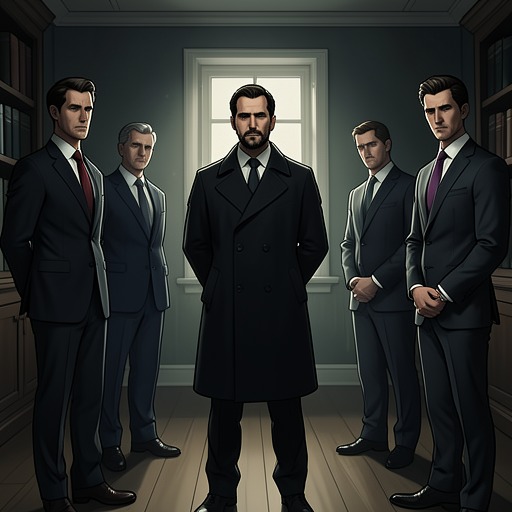
The Jackal—Marc Rodin
The Day of the JackalThe relationship between Marc Rodin and the Jackal is a transaction shaped by political desperation and a dangerous imbalance of knowledge. Rodin hires the foreign assassin to kill Charles de Gaulle, and the OAS’s wave of bank and jewellery robberies is driven by the need to finance that job. Rodin can authorize money and arrange support, but he cannot control the killer’s timetable or see how far the Jackal’s preparations have already advanced.
Recruitment and the Price of the Mission
The Jackal’s connection to Rodin emerges through the OAS’s concealed preparations. The three OAS chiefs had met the blond foreigner at Pension Kleist in Vienna before withdrawing to heavily protected hiding in Rome. The meeting gives the investigation a crucial link between the unknown killer and the organization’s leadership: the Jackal is not merely an opportunistic criminal, but an assassin retained for a particular political purpose.
Rodin’s confidence in the contract rests on money expected from the OAS’s supporters. When the combined OAS bank accounts in Switzerland exceed $250,000, he writes instructions transferring that sum to the Jackal. Rodin expects the remaining $250,000 to follow after de Gaulle’s death, when right-wing industrialists and bankers who had previously withheld funds would, he believes, rush to finance the soldiers who would become France’s new rulers. The payment therefore expresses more than the price of an assassination: it is an investment in a hoped-for political transformation.
The preceding robberies of banks and jewellers across France are part of the same financial logic. Rodin’s organization needs to demonstrate progress to supporters who have criticized its lack of initiative, while the Jackal’s fee gives the campaign a concrete, lethal objective. The contract binds the assassin’s work to the OAS’s political ambitions, even as the scale of the promised payment exposes how much the organization is staking on a single killing.
Intelligence, Control, and Divergent Timetables
Rodin’s authority over the operation is not absolute. André Casson objects when he sees the transfer instructions, reminding Rodin that they had promised the Englishman a Paris contact who could provide accurate, continuing information about de Gaulle’s movements and changes in his security arrangements. Since the President’s whereabouts and public appearances are no longer announced well in advance, Casson considers dependable intelligence essential to the mission’s success.
Casson has received word that his representative in Paris has placed an agent close to someone in de Gaulle’s immediate entourage. The agent needs several more days before he can reliably learn the General’s location, travel plans, and appearances. Casson asks Rodin to wait until he can give the assassin a Paris telephone number for receiving that information. His objection is tactical rather than a rejection of the assassination: he fears that paying the Jackal now might encourage him to act prematurely, before the promised intelligence is available.
Rodin reflects on the argument and agrees to delay sending the letter containing the contact number. The exchange reveals a division of labor within the conspiracy: Rodin authorizes the funds, while Casson works to establish an intelligence channel intended to make the attack more effective. Both men assume that a few days may still shape the killer’s conduct. In fact, neither knows that the Jackal has already selected his date and is proceeding with his plans and contingencies with clockwork precision.
The Relationship’s Dramatic Imbalance
The contract makes Rodin the Jackal’s employer, but not the master of his decisions. Rodin and Casson discuss when the assassin should receive money and information as though the operation remains open to adjustment; the Jackal has already made the decisive choice for himself. Their careful coordination is thus undercut by the very secrecy on which the plot depends. They believe they are preparing the conditions for the killing, while the killer’s independent schedule has moved beyond their knowledge.
That gap gives the relationship its central tension. Rodin treats the assassination as the opening to a political reversal and anticipates that success will unlock a larger flow of support. The Jackal, by contrast, appears in the available evidence as a professional whose chosen date and method of preparation are not governed by Rodin’s deliberations. The employer supplies money and seeks to supply information; the assassin retains control of the moment of action. Their alliance is real, but its apparent hierarchy conceals a fundamental limit on Rodin’s command.